
China offers Trump grand welcome, issues warning on Taiwan
Clip: 5/14/2026 | 7m 16sVideo has Closed Captions
China offers Trump grand welcome, but issues warning on Taiwan
Chinese leader Xi Jinping hosted President Trump and offered the U.S. a "new vision" of relations more focused on trade and collaboration than on confrontation. Trump in turn, offered a future in which he and Xi were "united and together." But China's president also had a stark warning to his American counterpart about Taiwan. Nick Schifrin reports from Beijing.
Problems playing video? | Closed Captioning Feedback
Problems playing video? | Closed Captioning Feedback
Major corporate funding for the PBS News Hour is provided by BDO, BNSF, Consumer Cellular, American Cruise Lines, and Raymond James. Funding for the PBS NewsHour Weekend is provided by...
China offers Trump grand welcome, issues warning on Taiwan
Clip: 5/14/2026 | 7m 16sVideo has Closed Captions
Chinese leader Xi Jinping hosted President Trump and offered the U.S. a "new vision" of relations more focused on trade and collaboration than on confrontation. Trump in turn, offered a future in which he and Xi were "united and together." But China's president also had a stark warning to his American counterpart about Taiwan. Nick Schifrin reports from Beijing.
Problems playing video? | Closed Captioning Feedback
Where to Watch PBS News Hour
PBS News Hour is available to stream on pbs.org and the PBS app.
Providing Support for PBS.org
Learn Moreabout PBS online sponsorshipAMNA NAWAZ: Welcome to the "News Hour."
Chinese leader Xi Jinping hosted President Trump today and offered the U.S.
a -- quote -- "new vision" of relations, more focused on trade and collaboration than on confrontation.
GEOFF BENNETT: President Trump, in turn, offered a future in which he and Xi were, in Mr.
Trump's words, united and together.
But China's president also had a stark warning to his American counterpart about Taiwan.
Nick Schifrin is in Beijing again for us tonight.
NICK SCHIFRIN: Today, through empty streets, an American president arrived in the heart of Beijing to fanfare and an outstretched hand.
Xi Jinping and President Trump met at the Great Hall of the People, the ceremonial center of communist China.
The goose-stepping was synchronized, the cheering choreographed.
And two geopolitical rivals suggested they both wanted a new era where confrontation could be replaced by collaboration.
It's been nine years since any American president came here, and the relationship between the United States and China has become much more fraught since then, in part because of President Trump's policies.
But President Trump today seems to be coming here determined to make deals, and the Chinese are determined to bring out all the pomp and circumstance.
DONALD TRUMP, President of the United States: It's an honor to be with you.
It's an honor to be your friend.
And the relationship between China and the USA is going to be better than ever before.
NICK SCHIFRIN: At an expanded bilateral meeting, President Trump and Xi Jinping echoed each other, what Xi labeled a new vision for bilateral relations.
XI JINPING, Chinese President (through translator): China and the United States should be partners, instead of rivals, helping each other succeed and prosper together.
NICK SCHIFRIN: But in the Chinese readout of the meeting, Xi Jinping delivered a warning about Taiwan -- quote -- "If it is handled properly, the bilateral relationship will enjoy overall stability.
Otherwise, the two countries will have clashes and even conflicts, putting the entire relationship in great jeopardy."
Xi didn't specify his demands, but U.S.
officials say China wants President Trump to block a future Taiwan arms sale and, if possible, change U.S.
diplomatic language from "We don't support independence for Taiwan" to "We oppose independence for Taiwan."
Today, Secretary of State Marco Rubio told NBC there would be no policy change.
MARCO RUBIO, U.S.
Secretary of State: From our perspective, any forced change in the status quo and the situation that there now would be bad for both countries.
NICK SCHIFRIN: But if there were any tensions today over Taiwan, technology or trade, they were not public.
DONALD TRUMP: China is beautiful.
NICK SCHIFRIN: And at a lush state dinner, the two leaders both connected centuries of history to a shared future.
XI JINPING (through translator): We agreed to build a constructive China-U.S.
relationship of strategic stability to promote the steady sound and sustainable development of China-U.S.
Relations and bring more peace, prosperity and progress to the world.
DONALD TRUMP: This bond of commerce and respect that stretches back 250 years is the foundation for a future that benefits both of our nations.
Together, we have the chance to draw on these values, to create a future of greater prosperity, cooperation and happiness and peace for our children -- we love our children -- this region and the world.
It's a special world with the two of us united and together.
NICK SCHIFRIN: That language is a world away from the end of President Trump's first term... DONALD TRUMP: In our war against the Chinese virus.
NICK SCHIFRIN: ... when his administration labeled China a strategic rival and announced an era of great power competition.
NARRATOR: The age of A.I.
has begun.
NICK SCHIFRIN: Today, that competition continues over advanced chips, military presence in the Pacific and trade.
And China buys 90 percent of Iran's oil, which President Trump today admitted to FOX would continue.
DONALD TRUMP: They buy a lot of their oil there.
They'd like to keep doing that.
He'd like to see Hormuz Strait opened.
NICK SCHIFRIN: But, for President Trump, today was a day for detente and deals.
TIM COOK, CEO, Apple: It's so great to be back in China.
NICK SCHIFRIN: He even brought CEOs to help push China to open for business.
JENSEN HUANG, CEO, Nvidia: President Xi was so gracious, so welcoming, and welcomed all of us to be part of China.
So, it was an excellent meeting.
Thank you.
NICK SCHIFRIN: But the reality is, for years, China has blocked some of the investments that Xi Jinping was promising today, and U.S.
policy, at least officially, has been making it harder, not easier, for the U.S.
and China to invest in each other's countries -- Amna.
AMNA NAWAZ: Nick, meanwhile, the president talks a lot about a closer relationship to China.
At the same time, many of this administration's policies treat China as a rival.
So how did those two ideas go together?
NICK SCHIFRIN: It's a great question.
You can go through the list, export controls.
For example, as we mentioned in the story, the U.S.
is trying to restrict the most advanced computer chips from China, for fear that those chips will end up in the Chinese military and perhaps confronting the U.S.
military one day.
Of course, the president has maintained tariffs on China, saying that China needs to be confronted in terms of economic policy.
And, of course, the military posture in the Pacific is designed to make sure that Taiwan is not engulfed by China, there's not a fait accompli of a Chinese invasion over Taiwan.
Of course, Xi Jinping got to make that statement, make that red line about Taiwan.
And, at this moment, at least, the U.S.
hasn't really responded to it specifically yet.
AMNA NAWAZ: And while we heard the president also emphasize economic deals as he's talking on this trip, this administration has also been trying to reduce that historic economic dependence between the two nations, right?
NICK SCHIFRIN: Yes.
No, it's a good point.
I mean, most U.S.
officials, from governors to mayors, over the last few years have begun to turn away from Chinese investment.
The consensus largely has been that Chinese investment is a national security risk, bad P.R.
for some of these states and cities.
And so, therefore, they have not been wanting this.
And, again, the U.S.
policy officially is not to increase those mutual investments.
Furthermore, the policy is also to repatriate factories, try and bring manufacturing back into the United States.
And if you were to do big deals with China, that could possibly move manufacturing toward China at a moment when a new American Chamber of Commerce study says that China's policies, industrial policies, are trying to increase foreign dependence on China, therefore increasing Chinese geopolitical leverage over these countries.
But perhaps most importantly from the Trump administration's priorities recently, it has been to diversify supply chains.
The U.S.
believes it'll take about seven years or so to get China out of critical supply chains.
And the notion of increasing investment into China could, again, lead to a moment that the U.S.
saw during COVID, where we were overdependent on China and we realized how vulnerable those supply chains were.
But, look, from China's perspective, Xi Jinping wants to be seen as open for business, open for investment, both into China, as well as into the United States and today, at least, certainly had an eager ear, it seems, in President Trump.
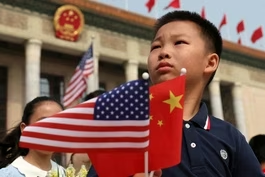
Analysts examine Trump-Xi call for stability and cooperation
Video has Closed Captions
Analysts break down Trump-Xi meeting and calls for stability and cooperation (8m 25s)

BLR celebrates 25 years of stories on illness and recovery
Video has Closed Captions
Bellevue Literary Review celebrates 25 years of stories on illness and recovery (7m 2s)

Florida's 'Alligator Alcatraz' expected to close
Video has Closed Captions
Florida's controversial 'Alligator Alcatraz' expected to close (5m 12s)

How reality TV stars seeking office are changing politics
Video has Closed Captions
How reality TV stars seeking office are changing politics (9m 21s)

Supreme Court extends access to mifepristone, for now
Video has Closed Captions
Supreme Court extends access to mifepristone, for now (3m 54s)
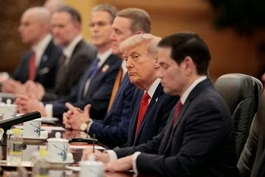
U.S.-China reset faces 'contradictions,' expert warns
Video has Closed Captions
U.S.-China diplomatic reset faces unresolved 'contradictions,' expert warns (3m 56s)
Providing Support for PBS.org
Learn Moreabout PBS online sponsorship New Episode
- News and Public Affairs

Today's top journalists discuss Washington's current political events and public affairs.

- News and Public Affairs

FRONTLINE is investigative journalism that questions, explains and changes our world.

 New Episode
 New Episode
 New Episode
 New Episode
 New Episode
 New Episode

 New Episode
 New Episode
Support for PBS provided by:
Major corporate funding for the PBS News Hour is provided by BDO, BNSF, Consumer Cellular, American Cruise Lines, and Raymond James. Funding for the PBS NewsHour Weekend is provided by...