
Do You Hear the Short “e” in Get?
5/1/2023 | 57m 42sVideo has Audio Description
LET’S LEARN about our five senses! Name a mystery food without using sight or smell.
LET’S LEARN about our five senses! Name a mystery food without using sight or smell. Count the ways Dewey the dog uses his eyes, ears, nose, mouth, and paws. Pretend to swim in a sea of flowers. Read MY HANDS TELL A STORY and words with short o. One-hour programs help children ages 3-7 learn in school and at home. Content provided by Education Through Music and NYC Children’s Theater.
See all videos with Audio DescriptionADProblems playing video? | Closed Captioning Feedback
Problems playing video? | Closed Captioning Feedback
Let's Learn is a local public television program presented by THIRTEEN PBS
Do You Hear the Short “e” in Get?
5/1/2023 | 57m 42sVideo has Audio Description
LET’S LEARN about our five senses! Name a mystery food without using sight or smell. Count the ways Dewey the dog uses his eyes, ears, nose, mouth, and paws. Pretend to swim in a sea of flowers. Read MY HANDS TELL A STORY and words with short o. One-hour programs help children ages 3-7 learn in school and at home. Content provided by Education Through Music and NYC Children’s Theater.
See all videos with Audio DescriptionADProblems playing video? | Closed Captioning Feedback
How to Watch Let's Learn
Let's Learn is available to stream on pbs.org and the free PBS App, available on iPhone, Apple TV, Android TV, Android smartphones, Amazon Fire TV, Amazon Fire Tablet, Roku, Samsung Smart TV, and Vizio.
Providing Support for PBS.org
Learn Moreabout PBS online sponsorship[gentle playful music] - [Narrator] Ready to learn?
- Hi!
- Hi, friends.
- [Narrator] It's time to share a story, read and write.
- Let's take it from the beginning.
- [Narrator] Discover science, sing.
♪ Hello friends ♪ - [Narrator] Play, and so much more.
- We're exploring with light.
- [Narrator] Stay tuned for lessons and activities.
- And the keyword is?
- Apple.
- Awesome.
- [Narrator] Funding for this program was provided by the JPB Foundation.
- Hi!
- Hello!
- My name is Shana and I have two special guests with me today!
- I'm Lyra.
- And I'm Aria.
- And today we are going to read a story to you.
But first, before we read, let's talk about our five senses.
So we do a lot of things with our hands.
Our hands can create things, grow things, and we also use our other senses.
What are other senses that help us use our hands.
- Sound.
- Sound.
- Smell, like- - Smell.
- If you smell something, you can smell the aroma.
Yes.
And that's my favorite part of cooking.
And sight to see it as we cook it, right?
We watch it.
And what else?
What else?
What's this?
Hearing!
- Hearing.
Very good.
- And taste.
- And taste.
So those are our five senses.
So I want you guys to think about that in the back of your mind while we read our story for today.
Our story is called, "My Hands Tell A Story."
The author is Kelly Starling Lyons, and the illustrator is Tonya Engel.
"'There's my Zoe,' Grandma says, waving me into the kitchen with a floured hand.
"Can I help?"
'Wouldn't be the same without you' she says.
I wash my hands and stand beside her at the table.
Grandma shows me how to kneed the dough into a ball that will rise like magic.
Her hands tell a story if you listen.
'I was just a little girl like you when mama taught me how to make cinnamon bread,' she said.
'Ingredients are only part of it.
You've got to get the rhythm.'"
- [Lyra] "Push and pull.
Push and pull."
- [Shana] "I try to do like grandma, but the dough bunches instead of flats.
It's sticky instead of smooth.
I frown at my hands and wonder if they will ever move like hers.
'Like this,' she says, sprinkling flour like fairy dust and placing her hands over mine.
We use the heels with our palms to push the dough forward.
Then we fold to pull it back again."
- "Push and pull.
Push and pull.
Until it's just right."
- [Shana] "I place the dough into a greased bowl.
Grandma covers with a cloth.
'Making bread takes time,' she says.
So, we sit and wait.
We sit and-" - "Talk."
- [Shana] "Her hands tell a story, if you-" - [Aria] "Listen."
- [Shana] "Grandma holds her palms in front of her like a map.
'They look like roads,' I say, tracing the lines.
She smiles like they go places only she knows.
'Wasn't easy,' she says, 'Typing and filing until my hands ached, then heading down to the studio at night.
some people said I should be happy I was working, but I had a dream of dancing on stage.'
I pictured grandma in spotlight.
Head raises towards the heaven.
Her hands weave a world without saying a word.
Then she takes off, leaping and twirling through time and space.
Her fingers are like branches stretching toward the sky.
I look at my hands and wonder what stories they will tell."
- "Where will they go?"
- "What will they learn?"
- Hmm.
"I glide a fingertip down grandma's rose-painted nails, and across her knuckles, I stop when I get to her wedding ring with flowers blooming on the band.
'When your granddaddy and I got married,' she said, "We bought a little land people said wouldn't grow a thing but weeds.
We broke up the soil, planted and tended, loved and believed.
Our blessings burst through that earth.
Yes, they did.'"
And the blessings burst through.
And what did they have?
What grew?
- Plant.
- A plant.
- Plant.
- Right, yeah.
- "Eating at their house always makes me feel special.
Gifts from their gardens stream in china dishes, squash and onions, collard green, candied yams.
Tangy smells tickle my nose and make my mouth water.
I wonder if one day my hands will grow something too.
Before I know it, we need to check the dough.
I can't believe how big it has swelled.
We flatten it, then dust it with cinnamon sugar.
Next we roll it up and lay it in the pan.
I cover it with cloth so it can rise again.
'Let's get some air,' Grandma says.
Outside on the glider, the wind whistles.
And grandma rubs my head, soft as a whisper.
I hear murmurs of her hand flowing and dancing, praying and planting, stroking my ear when she thinks I'm asleep.
And something happens.
I look at my hands.
I really look at them For the first time.
I can see memories in every line."
- "Clapping games with friends."
- "Drawing my dreams."
- "Building and baking.
'Time for the oven!'
Grandma says, rising to go inside.
While we wait for our bread to be ready, I think about the power in my hands.
They can turn pages, color, and create.
What will tomorrow bring?"
Hm.
"When grandma puts down her crossword puzzle, I jump up and race to the oven."
- "It's time."
- "It's time!
She cuts hunks of our cinnamon swirls bread.
The spicy aroma makes me wiggle.
I spread butter that melts into each nook.
We take a bite and slap our hands together.
Grandma stares at my fingers like she's seeing something new.
"You have my hands,' she says.
Our fingers are long and skinny, sweet brown, like sugar, made for holding and reaching.
'But you'll go places I've never been,' Grandma says with pride.
I see my hands raised in victory as I cross the finish line.
I see them making music.
I see them writing about grandma and me.
At home, I type on my computer and here the tap tap rhythm, softly first, and then louder and stronger."
- "The words fly out."
- "Like they're sailing on a breeze."
- [All] "My hands tell a story, if you listen."
- The end!
- There.
- The end.
- We're making a painting that will smell like fruit.
We're using some non-toxic glue, artificially flavored gelatin powder.
That gives the painting it's scent.
And water.
Ask a trusted adult to help you squeeze glue on the parts of your drawing where you want your colors and scents to be.
You can use a brush, a q-tip, or fingers to spread out the glue.
Next, sprinkle colored gelatin powder where there's glue.
We use strawberry and orange.
Dust all the extra powder.
Before long, you'll see your gelatin powder change colors.
Then you can sprinkle water on the powder to help the colors change faster.
Make sure to ask your adults to help you and have some napkins handy.
Things can get a little messy.
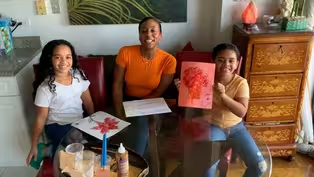
- So here are our finished products.
- This is Aria's scented flower.
- [Aria] So it is red on the petals, and in the middle where the big seed is, it is orange.
- And this is Lyra's delicious scented cupcake.
- Here's my beautiful cupcake.
It's mostly red, and the sprinkles are orange, and the bottom, like, the wrappings orange.
Can't wait to see what you guys create at home.
- Yeah.
See you next time!
- Bye, guys!
- Bye!
[gentle playful music] - Hi, friends.
- Welcome to a wonderful Day of learning.
My name is Anna.
And I was just thinking about all the things people like to tell.
Like, I love to tell stories, especially when they're really funny.
My youngest daughter, she loves to tell secrets.
Her favorite secret?
"I love you."
I know.
I love that secret too.
My oldest daughter, she's into telling jokes lately.
You wanna hear her favorite joke?
It's, "What do you call two birds in love?
Tweet hearts."
Get it?
Instead of sweethearts, tweet hearts.
There's a lot of things people like to tell, but you know what I noticed?
In the word tell, tuh eh eh, that middle vowel sound.
That's actually going to be our focus sound for today.
Today we're going to be reviewing the sound of short E. Okay?
Short E makes the eh sound.
I'm gonna put you right here for now.
But before we do that, let's get our ears ready to do some work with sound, okay?
First what I'm going to do is I'm gonna give you two parts of words and I want you to blend them together.
So for example, if I said butter fly, you would put them together and you would say butterfly.
Okay, let's do a couple of these.
How about cat nip?
Catnip.
Basket ball.
Basketball.
Home work.
Homework.
All right, last one.
Base ball.
Baseball.
Okay, now let's do something where I'm gonna give you sounds.
Smaller units, now, not word parts.
And I want you to blend those together.
So let me give you an example.
If I were to say cuh ah tt.
I would want you to blend those sounds together and tell me cat, because cuh ah tt put together says cat.
Okay, how about this one?
Mm, eh, tt Met.
Good job.
How about this one?
Puh ih tt.
Pit.
How about this last one?
Listen carefully.
Ff ll oh tt.
Float.
Good job!
You notice how I added that extra sound in there?
Cool, right?
Okay, let's review some of the letter sounds that we'll be working with to create our word chains today, okay?
So I'm gonna show you a letter.
I want you to first tell me the letter name, then tell me the sound it represents.
So if I showed you the E, you would first say E, and then the sound that we're working with today is A, okay?
What's the letter?
M. And what sound does it represent?
Mm.
Good job.
Make sure those lips are together.
Mm.
What's the letter name?
T. And what sound is it represent?
Tt.
What's the letter name?
V. And what sound does it represent?
Buh.
Great.
What's the letter name?
L. And what sound does it represent?
Ull, good.
What's the letter name?
D. And what sound does it represent?
Duh.
Last one.
What's the letter name?
F. And what sound does it represent?
Ff.
That's right.
Use that T with your lip.
Ff.
That sound.
Awesome.
Okay, so let's start our word chain.
Now remember, all of our words in our word chain today will have the same vowel sound.
Which is that eh sound.
Everyone say the sound again.
That's right, eh, like Ed.
Okay, so the first word I wanna build is the word met.
How would we build the word met?
What sound do we hear in the beginning?
We know the sound in the middle, eh.
And then what's the sound at the end?
Hmm.
Let's see.
Met.
Let's stretch it.
Met.
What letter represents that first sound?
That's right.
We have our M representing that mm sound.
Okay, so mm eh tt.
What do I need here for that tt?
That's right.
I should have my T. All right, let's blend it through.
Ready?
Mm eh tt.
Read it?
Met.
Okay.
Now how do I turn met into bet?
Like, I bet you can figure this letter out.
That's right.
I'm going to need the letter B representing that buh sound.
But now where does it go to change bet?
Hm.
Met, bet.
You're right.
I'm gonna change that first sound.
So away goes the mm and in in goes the buh.
So let's blend it and then read it.
Buh eh tt.
Read it.
Bet.
All right.
How do I change bet into bed?
Like I really wanna take a nap in my bed right now.
Okay.
Stretch it if you need to.
Bed.
Bed.
Where do we hear the change in sound?
That's right.
The ending.
So we're gonna say goodbye to tt, and then what are we going to add for bed?
That's right, our D. Blend it, read it.
Buh eh duh.
Bed.
All right.
How do I turn bed into led?
Like, I led the line.
You're right.
I'm gonna get rid of my buh, and I'm going to put in the L, representing the ull sound.
All right, let's blend in and read it.
Lead.
Lead.
Okay, now here is a tricky one.
Can you turn lead into fled?
Like he fled the house?
Like, to run away.
Do I have to remove something to turn lead into fled?
No, I don't.
I just need to add which letter to represent which sound?
That's right, fled.
So when we stretch it, fled, and instead of lead, I now hear that ff sound and we know that F represents that sound.
Alright, let's blend this one.
Fuh Fled.
Read it?
Fled.
Excellent job.
Okay, let's try blending some more words with that short E sound, which is what?
That's right, eh.
Like Ed.
Let's start with the first line.
Let's blend it and then read it.
Ready?
Come on.
Et.
What's the word?
Et.
Buh et.
Read it?
Bet.
En.
En.
Huh en.
Hen.
Ed.
Ed.
Led.
Led.
Okay, now we're getting to some words here!
Let's do this.
Ff eh duh.
What's the word?
Fed.
Err eh duh.
Red.
Buh eh duh.
Bed.
Okay.
Now notice, I have a challenge word down here.
Let's see if we can figure it out.
Let's blend all those sounds together to figure out this word.
We can do it.
Ss wuh eh puh tt.
Ooh, what's this word?
Swept!
Right!
Like, he swept the floor.
Awesome job.
Thank you so much for learning and playing with me today.
I hope you have fun learning and reviewing the short E sound, which is what?
That's right, eh.
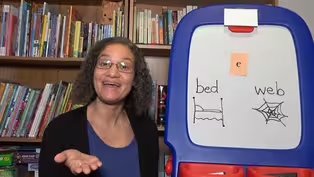
Like Ed, or as you hear it in bed and web.
Have a great day, and continue looking for those short E words around you.
I'm gonna go find my daughter and see if she can tell me some more jokes.
Tweet hearts!
So funny!
Bye.
[gentle playful music] - Hi, I'm Tiberius, and today we're gonna make banana pancakes.
We got eggs, bananas, oats, and brown cinnamon.
We're gonna add the bananas and the eggs first.
Now we're gonna mash it up.
Now lets add some oats.
Now cinnamon.
Next we're gonna mix it.
Next we're gonna add some butter on the stove.
Now you pour it in.
it's time to flip.
Done!
Now, it's time to eat!
[gentle playful music] - [High-Voiced Narrator] Hi, friends at home.
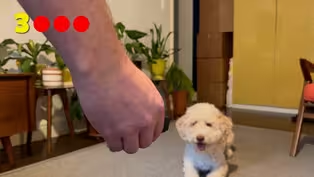
This is Dewey.
He is a mini Labradoodle.
- [Omar] We love Dewey so much.
I especially love when we're sitting on the couch and he puts his paw on me.
- [High-Voiced Narrator] I love that even though Dewey speaks dog and I speak a human language, we can still talk to each other.
- [Omar] Wait, how do you talk with Dewey?
- [High-Voiced Narrator] Well, I watch his body language and the way he uses his senses to take in the world.
- [Omar] Yeah, that is him talking to us.
His body tells us what he needs.
Actually, paying attention to his needs is part of how we care for him.
- [High-Voiced Narrator] Yeah.
And loving Dewey means caring for him, which can be a lot of work, but it can also be a lot of fun.
- [Omar] We can even make it into one big game.
As Dewey senses what's around him, let's observe him closely and count his actions.
Friends at home, count with us.
Join us as we care for and count with Dewey.
One way we care for Dewey is feeding him.
He gets one cup- - And a little more.
- In the mornings, and in the evenings he gets one more cup.
- [High-Voiced Narrator] And a little more.
- That's two cups- - And a little more.
- [Omar] [chuckles] Each day.
- [High-Voiced Narrator] Look how patiently he is waiting for his food.
We also have to make sure Dewey has time to play every day because it's his favorite activity, and it's good for his brain.
Wait, Omar, isn't play good for our brains too?
- [Omar] You know it is.
- [High-Voiced Narrator] Well, Dewey loves and I mean, loves to play.
Look how carefully his eyes follow his favorite toy.
Let's count how many tosses he catches.
One.
- [Omar] Two.
- [High-Voiced Narrator] Three.
- [Omar] Four.
Dewey also loves to taste ice cubes.
- [High-Voiced Narrator] And then he plays soccer with them.
- [Omar] Which most people in the world call football.
- [High-Voiced Narrator] [chuckles] Okay.
So we start with one ice cube and then- - [Omar] Dewey breaks it into two pieces.
- [High-Voiced Narrator] Two icy soccer footballs.
Watch him play, friends at home.
- [Omar] Another big way that we care for Dewey is by taking him for walks every single day.
Walks are one way he gets exercise which keeps his body healthy.
That's what we're about to do right now.
Go for a walk around the neighborhood.
Friends at home, join us.
[gentle music] [birds chirping] - [High-Voiced Narrator] Oh, I love going for walks.
I see the leaves.
- [Omar] Oh, and I feel the breeze on my face.
- [High-Voiced Narrator] And I hear the birds chirping.
- [Omar] I wonder what Dewey's sensing.
Let's pay close attention to him to find out.
- [High-Voiced Narrator] Well, I see him sniffing.
He loves to sniff a lot.
- [Omar] Well, you know, dogs can't see as sharply as humans can.
Instead, smell is a dog's most powerful tool for taking in the world.
They can smell way better than we can.
- [High-Voiced Narrator] Yeah.
And you know, smell is even how Dewey says hello.
Let's count how many dogs Dewey sniffs to say hello.
One.
- [Omar] Two.
- [High-Voiced Narrator] Three.
Three dogs.
- [Omar] While we're on our walks, Dewey also loves to get his energy out by running.
- [High-Voiced Narrator] Shaking his body.
- [Omar] And catching sticks.
Oh, look, he's pulling on the leash.
He must be trying to tell us something.
He's showing us that there's something he wants to do.
- [High-Voiced Narrator] [chuckles] I know what it is.
He knows that we're close to his favorite water fountain.
- [Omar] Friends at home, let's count how many times Dewey jumps at the water to get a taste.
One.
- [High-Voiced Narrator] Two.
- [Omar] Three.
- [High-Voiced Narrator] Four.
- [Omar] Five.
- [High-Voiced Narrator] Six.
- [Omar] Seven.
- [High-Voiced Narrator] Eight.
- [Omar] Nine.
- [High-Voiced Narrator] Ten.
- [Omar] Eleven.
- [High-Voiced Narrator] Whew.
It's hard to keep up with Dewey.
I'm getting tired.
Omar, let's head back home.
- [Omar] You know, I've learned so much about the way Dewey senses the world today.
First we saw him taste his food.
- [High-Voiced Narrator] Next we saw him follow the toy with his eyes, then taste and play soccer with an ice cube.
- [Omar] Then you saw him go for a walk and smell his friends.
And don't forget my favorite: when he touches his paw against my arm.
Friends at home.
How do you take in the world?
What about the room around you right now?
- [High-Voiced Narrator] Do you smell anything with your nose?
- [Omar] How do things feel around you?
- [High-Voiced Narrator] What do you see with your eyes?
- [Omar] What do you hear with your ears?
- [High-Voiced Narrator] What is one thing you have tasted with your tongue today?
What did it taste like?
- [Omar] When we listen to our five senses and our bodies, we are more aware of what we need.
- [High-Voiced Narrator] And what others need.
Like how paying attention to Dewey helps us care for him.
- [Omar] Friends at home, pay attention to your senses and the senses of others.
You may be surprised by what you learn.
Thanks so much for joining us on our day with Dewey.
See you.
- [High-Voiced Narrator] Bye!
[bright music] - Cut.
Yeah.
[Brian laughs] - My name is Brian.
My wife Artith and I have two children: Cedril and Draelyn.
All of our schedules are busy and we're all trying to balance our crazy hectic life.
Oh, keep using that.
We try and incorporate breaks throughout the day for fun family activities and exercise.
Or creative time where they can be away from the screen.
[Brian laughs] [ukulele strums] The kids can get refocused and re-energized and I think it overall helps with the stress levels.
A really great thing we've been doing recently is having grandpa reading time, where we dial in with my stepfather and he's been helping the kids with our reading.
- Hi, Drae-drae!
- Hi.
- Are we ready for some new words?
- Yeah.
- Grandpa will often prepare things based on what they're learning in school.
He's been putting together these things for my daughter, working with words and adding in family pictures to get her really excited.
- On top of her papa.
- And there you are sitting right up on his shoulder side.
- It's really been a win-win situation as it gives me some more free time.
And the kids have really been enjoying their quality time with grandpa, and their reading has really improved because of it.
- Well, very good, Drae.
You did great today.
- It's been such a great way for us to stay connected with the family.
- Thank you!
[bright music] - Hi friends.
My name is Cassondra and these are my helpers.
- Noel!
- And Emery.
- And we're here today to do a fun science experiment with you.
So today we're talking about our five senses.
Now let's talk about what those five senses are.
So Noel, can you tell us one of our five senses?
- Touch!
- You can use hands.
- Touch!
- Okay.
Your sense of touch using your hands.
- Emery, can you tell us another one?
- Your ears.
- What sense do you use your ears for?
- They hear!
- Yes.
We use our ears to hear.
All right.
Noel, can you tell us another one of our five senses?
- Sure!
Your eyes!
- Great!
We use our eyes for our sense of sight.
Emery, tell us another one.
- Your tongue.
- What's that tongue for?
- The taste.
- Tasting with your tongue.
Show everybody that tongue.
[kids vocalize] - Okay.
And Noel, tell us one more.
- Smell!
- Smell?
- Using your nose!
- Alright, we use our nose to smell!
So those are our five senses.
And today we are going to be using those fives to see if we can figure out what these mystery items are.
What do you usually do with your senses?
How your senses help you?
Hmm?
Tell me when your senses have helped you besides figuring out mystery items.
- Hmm.
The taste.
- Yeah.
So your senses help you to taste anytime you're eating food.
What else?
- One is when I go on the streets, to look for cars, my sight helps me.
- Oh, that's really good.
So your senses help to keep you safe?
- Yes.
- Okay.
- How else do our senses help us?
- To smell food!
- Oh, to smell food.
Or maybe sometimes to smell if something's burning.
- Oh yeah.
- Yeah.
That could also be a way that our senses, they help us to learn about what's going on around us and help to keep us safe.
- And to help you get a look about all the things around you.
- Excellent.
All right, great.
So today we're gonna use those senses and we're going to see if we can take those clues that our sentences give us and see if we can figure out what these mystery items are.
So Noel, Emery, are you up for this challenge?
- Yes.
- Okay.
So I'd like you to put that blindfold over your eyes so that you can't see our mystery items yet.
How is that?
Is that good?
- Yep.
- Yeah!
- Is that all right on you, Noel?
- Yep.
- Is that all right on you, Emory?
- Yes.
- Yep.
Okay, great.
Now, can you take your fingers and plug your nose so that you can't smell our mystery items either?
Are you okay?
- Yeah.
- Okay.
- Yes.
- We're gonna get the first mystery item.
All right.
I'm gonna put this in your hand.
And I want you to touch it.
Use your sense of touch.
What you notice when you touch that item?
- It feels wet.
- It feels wet.
What else?
- Slippery.
- It feels slippery.
Okay.
Anything else?
- Kinda moist.
- Keep that nose plug!
- It feels like it has skin on it.
- Skin on it!
- Okay.
Do you know what that item is yet?
- I don't know.
- I don't know yet.
- Not sure yet?
Okay.
So I'm gonna put a check mark over here because we've had one clue so far for our first mystery item.
Now I'm gonna take this mystery item and we are going to use our sense of hearing.
Keep that nose plugged.
Now I'm gonna let you hear what this item sounds like, okay?
Now, don't tell me what it is yet if you know, just listen.
Okay, Noel and Emory, what did you notice with that mystery item?
- Oh, I know what it is!
It's my favorite veggie.
It's a pepper.
- What?
You knew it.
How did you know that was a pepper?
What did you hear?
- It crunching.
- Oh my goodness.
You heard it crunching.
Did you notice that, Noel?
- Yes!
- Did you also know what was a pepper?
- I actually thought it was a vegetable of some kind.
I Didn't know yet.
- Okay.
So, let's have you take off your blindfold for a second.
I'm gonna put a smiley face over here under hearing, because your sense of hearing made you know what the first history item was.
Now let's open up the bag and see if you were right about that mystery item.
- Yes!
- Yay!
Is that your favorite veggie, a pepper?
- Yeah!
- Okay.
So we were right.
The first mystery item is a pepper.
Alright, good.
Now let's go on to our next mystery item.
All right, put those blindfolds back on.
[playful music] All right, we ready?
- Yes.
- Okay.
Plug your nose.
Plug that nose.
Are we ready?
- Yes!
- Yes!
- Okay.
Let me get that second mystery item.
Alright, I'm going to put it in your hand so you can use your sense of touch.
Here we go.
You ready, Noel?
Okay, touch that second mystery item.
What does it feel like?
- It feels like, hard at the top.
- Feels hard at the top.
- I have literally no idea.
- [laughs] No idea.
Okay, I'm gonna put a check mark for item under two, under touch, because we got to touch that mystery item.
All right, now we're going use our sense of hearing, okay?
Listen.
What did you notice?
- I heard like, nothing.
- You heard nothing?
- Yeah.
- Did you hear anything Noel?
- Just that, like, rubbing against my ear.
- Okay.
So I'm gonna put checkmark under hearing for mystery item number two.
So those clues haven't helped us much.
- No.
- Okay.
Now for the sense of sight, you're gonna peek under your blindfold and look at what color our mystery item number two is.
What color is mystery item number two?
Look at this right here.
- It's white.
It looks white.
It's white.
Okay.
- So mystery item number two is white.
Does that make you know what item it is?
Not at all.
- No.
- No?
Okay.
We'll put another check mark.
Okay, now keep that nose plug!
Alright, you're gonna taste it.
Here's the taste.
You ready?
Don't smell it yet.
Just taste it.
What is this taste like?
- It tastes like a potato.
Oh, you smelled it.
Did you smell it?
- No.
Eating it, it's a potato.
- Yeah.
- Whoa, Emory's really good at this experiment.
- It tasted weird, but I think it's [indistinct].
- It's definitely a potato.
- A potato.
Okay.
- Yeah.
So take off your blindfold and let's look at the second mystery item and see if you were right.
I did not taste anything.
- Knew it!
- Potato!
- It tastes so weird.
- Okay, so we got a potato for our second mystery item.
Okay, blindfold back on.
Last mystery item.
Now remember, keep that nose plugged, okay?
When we get to teeth, keep it plugged because we don't wanna smell it yet, okay?
Alright, here we come with our last mystery item, and I'm gonna have you touch it.
Here we go.
Touch that last mystery item.
Touch it.
How does it feel?
- Feels like... - I don't even wanna know.
- It feels like, wet.
- Do you know what it is?
- Not even at all.
- No.
- Okay, we'll put a check there.
All right.
Let me have it.
Let's use our sense of hearing.
Listen.
Did you hear it?
- Kinda.
- What did it sound like?
- It like sounded like something popped.
- Like, a pop?
Do you know what it is?
- Like, a lemon?
- I think it's some kinda veggie.
- Like a lemon?
- Like a lemon.
You're very close.
All right, so we've gout our sense of hearing.
- Actually, no, I have one thing I think it might be.
- What?
- Is it a lime?
- Okay, take a peek at the color.
What color is this mystery item?
- Orange!
- Orange!
- Does that make you know what it is?
- Yes!
- What is it!
- It's an orange!
- It's an orange!
You figured it out.
Okay, let's take a look at the last, you can take your blindfold off.
And let's look at the third bag at our third mystery item and see if Noel was right.
- I knew it.
- Orange.
- Was he right, friends at home?
- Yes!
Our third mystery item was an orange.
Thank you so much, friends at home, for joining us.
Thank you Noel and Emory, for using your five sentences to figure out our mystery items.
We hope you can try something like this at home, friends, using your five senses to figure out some mystery items.
Thank you for joining us, friends.
- [All] Bye!
- Bye!
[upbeat music] - My name is Brian.
[translator drowns out Brian] [translator speaking Spanish] - Hi, Drae-Drae!
- Hi!
- Are we ready for some new words?
- Yeah.
[translator speaking Spanish] - On top of her papa.
- And there you are, sitting right up on his shoulders.
[translator speaking Spanish] - Well, very good, Drae, you did great today.
[translator speaking Spanish] - Thank you!
[gentle playful music] - Hello, everyone!
My name is Ms. Caitlyn and I'm a teaching artist with New York City Children's Theater.
Today we're going to use our voices, bodies, and imaginations to do a theater activity together.
Are you ready?
Let's go.
Today, we're going to explore our five senses.
Do you remember what your five senses are?
Let's do them together.
Ready?
We see, we hear, we smell, we touch, and we taste.
Those are our five senses.
Today, we're going to go on an adventure that uses our five senses.
Are you ready to explore with me?
Let's get started.
The first thing we need to do is turn on our imaginations.
Our imaginations are going to help us imagine or pretend when we go on our adventure.
There are three steps to turning on our imagination.
Will you do these steps with me?
Awesome.
Step one, we need to wake up our imaginations.
So can you do raindrop fingers on your body?
Starting at your head?
Wake up that imagination.
Very nice.
Step two, we need to energize our imagination.
So can you shake that body to energize the imagination?
Nice job.
And step three, time to turn it on.
Ready?
Turn on your imagination!
Can you make your body into a starfish pose?
Ready?
Turn on your imagination.
Nice work.
Now that our imaginations are turned on, we are ready to go on our adventure.
Today we're going on a, drum roll, please.
[imitates drumroll beating] [cymbals crash] An ocean swimming adventure.
Now this is a magical ocean, which means the waters are changing all the time.
So we will have to practice our super swimmer skills.
Can you show me how you swim?
Awesome.
So we can move our arms like this when we're swimming.
Before we go on this magical ocean swimming adventure, we need to put on our swimming gear.
So first, bathing suits.
Woo, woo, woo.
Nice.
And floaties.
Joop, joop.
Just in case.
Flippers on your feet.
Woop, woop.
And last but not least, goggles.
It's time to dive in.
Follow me.
Arms up, hands together, and dive in.
Splash!
Whoa, we are in the ocean.
Look down.
This is the clearest and cleanest ocean I have ever seen.
I can see all the way to the bottom of this ocean.
What do you see?
I see bright coral and shiny fish and bright green seaweed.
Alright, let's keep swimming.
Whoa, I think the ocean is changing.
Do you hear that?
I, oh.
I think the fish are singing.
What song do you hear in this singing ocean.
Oh.
Can you sing the song that you're hearing for me?
Oh, nice.
I hear.
[hums softly] Oh, wow.
All right, let's keep swimming.
Another change is happening.
Look, the water is turning into flowers!
Oh my goodness.
They smell amazing.
Can you take a deep breath with me and fill your nose with the smell of flowers?
Oh, I love this ocean.
Wow!
All right, let's keep swimming.
Oh look, the water's changing again.
Oh my gosh.
The ocean is filling up with teddy bears.
Ooh.
They're so soft and fuzzy!
Do you feel them?
How do the teddy bears feel on your skin?
Wow.
This is the softest teddy bear ocean ever!
[laughs] Oh, let's keep swimming.
I think the ocean is changing one more time.
Oh, it's getting really hard to swim.
I think it's a jello ocean now.
Oh no.
Can you try to swim through the jello with me?
It's not working.
I know what we have to do.
We are going to have to eat our way through this jello ocean.
Can you take a big bite with me?
Ready?
Ooh.
What flavor is your jello ocean?
Delicious.
Okay, keep eating so we can swim our way out.
Oh, keep eating.
Oh good.
We made it!
That was one wild magic ocean.
Good thing we had our five senses to help get us through.
Wow.
Our imaginations helped us go on a really big adventure.
What was your favorite part of our adventure?
I liked that part too.
My favorite part was hearing all of the songs and the magical musical ocean.
Our swimming adventure has come to an end, but you can use your imagination and your five senses everywhere you go, and create your own adventures.
What adventure will you go on next?
I had a wonderful time exploring our five senses with you today.
And on behalf of everyone at New York City Children's Theater, thank you so much for playing and imagining with me today.
Goodbye.
[gentle playful music] [slow bass music] ♪ Hola amigos ♪ ♪ Hola amigos ♪ ♪ Hola amigos ♪ ♪ Como esta ♪ - Hello everybody.
Welcome to this music time.
I'm so happy you are here.
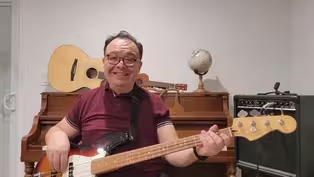
This is Mr. Martinez, and today I brought another instrument.
This is a real low instrument.
Yes.
Its name is the electric bass.
This one has four strings.
Which other instrument that we play before has four strings?
So, you're right!
Ukulele, perfect, but this one sounds really low.
There are some bases that they have five strings or six strings or seven strings.
But this is the basic one and the sound is super deep.
That's why it is called the bass.
And today we're going start saying, hello.
Here we go.
♪ Hello friends ♪ ♪ Hello friends ♪ ♪ Hello friends ♪ ♪ It's time to say hello ♪ Yeah!
In China, the way you say hello is ni hao.
Say it with me.
Ni hao.
Yeah, and it will be easier if you sing it with me.
Here we go.
♪ Ni hao ♪ ♪ Ni hao ♪ ♪ Ni hao ♪ ♪ It's time to say hello ♪ How It's time to say hello.
Do it again!
♪ Ni hao ♪ ♪ Ni hao ♪ ♪ Ni hao ♪ ♪ It's time to say hello.
♪ Yay!
That was amazing.
Today I would like to start with a little game.
This one is a frozen game.
When I say the word coo coo!
Coo coo!
You'll get frozen.
But I brought a friend of mine that will help us.
His name is Mr.
Stick.
Yay!
Mr.
Stick has a shape.
If you put your feet like this and your hands like this, you will get the shape that Mr.
Stick is doing.
Ooh, that was perfect.
As you can see, Mr.
Stick has no mouth, so he doesn't talk.
That's why while we're singing, we're singing.
But when we get Mr.
Stick's pose, we don't talk.
I know you are able to do this.
Get frozen and Mr.
Stick shape.
Okay.
And this song sounds something like this.
[slow bass music] ♪ Aloha Hawaii ♪ ♪ Aloha Hawaii ♪ [yodels] Coo coo!
And when I say coo coo, you'll get frozen.
Are you ready?
Okay.
So I have some Mr.
Sticks poses over here.
I'm ready to play with you.
Sing with me.
♪ Aloha Hawaii ♪ ♪ Aloha Hawaii ♪ [yodels] Coo coo!
Oh yes.
I can see that you have the legs like Mr.
Stick and you have your hands like Mr.
Stick.
And you are not talking.
You're not talking.
'Cause you have Mr.
Stick pose.
Oh, what are you doing, Mr.
Stick?
What?
Woo!
That was amazing!
Aloha Hawaii!
♪ Aloha Hawaii ♪ ♪ Aloha Hawaii ♪ [yodels] Coo coo!
Get frozen.
Yeah!
Look at this.
This is Mr.
Stick.
You ready?
Oh, Mr.
Stick, what are you doing?
Oh my goodness, this is too hard!
Come on, Mr.
Stick!
It's time to sing!
♪ Aloha Hawaii ♪ ♪ Aloha Hawaii ♪ [yodels] Coo coo!
Yay!
Oh, I can see you have Mr.
Stick's pose.
Amazing.
But what are you doing Mr.
Stick?
What are you doing Mr.
Stick?
Oh my goodness.
We're gonna get this.
No way!
Let's sing together.
♪ Aloha Hawaii ♪ ♪ Aloha Hawaii ♪ [yodels] Coo coo!
Get ready!
Oops.
This is really hard.
Mr.
Stick.
Who can do this?
Oh, what are you doing, Mr.
Stick?
What are you doing, Mr.
Stick!
Oh my goodness.
Whoo!
♪ Aloha Hawaii ♪ ♪ Aloha Hawaii ♪ [yodels] Coo coo!
Why not you create your own Mr.
Stick.
Show me.
Show me.
You have your own idea?
Wow!
That was amazing!
That was great.
I really loved it.
Today I have a special mission for you.
Today we will use our voice and we will use our finger to help a little bird to find the nest.
There's a little bird that's a little lost.
And she needs to go back to the nest, okay?
So for that today, I would like that we can use our voice and we can follow also, that way that the bird can fly.
Will you help me?
Let me show you.
This is the bird right here.
And this is the way she will fly to get the nest.
So we will use our finger.
Yeah.
Good job.
And we'll use our voice like this.
[vocalizes] Hey, that was fantastic.
Will you try it again one more time?
[vocalizes] Yeah, that was a good job.
But I have a surprise.
Maybe we can find another way to help this bird to get her nest.
What about this one?
Show me your pointing finger.
You ready?
Oh, we'll start with a really high pitched sound.
Like this sound.
You ready?
One, two.
Here we go.
[vocalizes] Hey.
That was fantastic.
Let me hear your high pitch again.
One more time.
One, two, here we go.
[vocalizes] Woohoo, that was fantastic.
But I have a challenge for you.
I don't know if you're ready for this.
I have this challenge.
Oh, take a...
Sorry.
[laughs] Take a look to this one.
We are gonna help this bird.
Mm.
How it sounds?
You know how it sounds.
Okay, let's try it together.
Let's start with this sound.
One, two, with your finger.
[vocalizes] Oh, [pants] we need to take a huge breath.
Let's try it again.
One, two.
One more time.
[vocalizes] Yeah.
Good job.
I have a last challenge for you.
Maybe you will be able to get this.
Oh, take a look, please.
Take a look for one moment.
Take a look.
Mm hmm.
I know how it sounds.
I know how it sounds.
We'll do it together.
One, two, here we go.
[vocalizes] That was a hard work.
I'm so glad that you did it.
And what about if you create your own one?
Maybe you can get out a piece of paper and you can draw the bird and you can draw the nest and you can create your own one.
That was amazing.
But it is time to say goodbye with Mr. Bass that was today here to help us to sing and play and play games.
So it's time to say goodbye.
♪ Goodbye friends ♪ ♪ Goodbye friends ♪ ♪ Goodbye friends ♪ ♪ It's time to say goodbye ♪ ♪ [gentle playful music] - Funding for this program was provided by the JPB Foundation.
♪ [bright music]
Video has Audio Description
Shana Davis reads MY HANDS TELL A STORY by Kelly Starling Lyons. (8m 42s)
Video has Audio Description
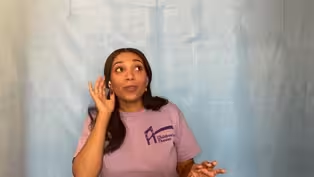
Caitlyn McCain of NYC Children’s Theater uses her senses on an imaginative ocean journey. (6m 43s)
Video has Audio Description
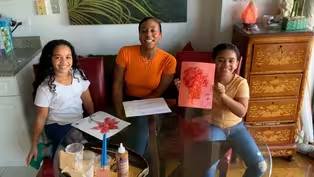
Shana Davis reads MY HANDS TELL A STORY by Kelly Starling Lyons. (8m 42s)
Video has Audio Description
David Martinez prompts children to play musical games using drawings. (10m 23s)
Video has Audio Description
Lily Fincher and Omar Etman count the ways Dewey the dog uses with his senses. (7m 18s)
Video has Audio Description
Anna Scretching-Cole helps children learn about the short e vowel sounds. (9m 14s)
Using Senses to Identify Mystery Foods
Video has Audio Description
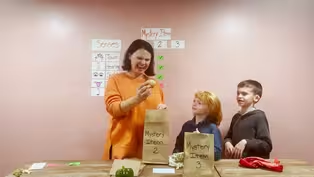
Cassondra Easterling helps children use their five senses to make scientific observations. (9m 59s)
Providing Support for PBS.org
Learn Moreabout PBS online sponsorship













Support for PBS provided by:
Let's Learn is a local public television program presented by THIRTEEN PBS