
July 7, 2026 - PBS News Hour full episode
7/7/2026 | 57m 46sVideo has Closed Captions
July 7, 2026 - PBS News Hour full episode
July 7, 2026 - PBS News Hour full episode
Problems playing video? | Closed Captioning Feedback
Problems playing video? | Closed Captioning Feedback
Major corporate funding for the PBS News Hour is provided by BDO, BNSF, Consumer Cellular, American Cruise Lines, and Raymond James. Funding for the PBS NewsHour Weekend is provided by...
July 7, 2026 - PBS News Hour full episode
7/7/2026 | 57m 46sVideo has Closed Captions
July 7, 2026 - PBS News Hour full episode
Problems playing video? | Closed Captioning Feedback
Where to Watch PBS News Hour
PBS News Hour is available to stream on pbs.org and the PBS app.
Providing Support for PBS.org
Learn Moreabout PBS online sponsorshipAMNA NAWAZ: Good evening.
I'm Amna Nawaz.
GEOFF BENNETT: And I'm Geoff Bennett.
On the "News Hour" tonight: The U.S.
launches new strikes against Iran, as President Trump meets with NATO leaders in Turkey and pushes for more military spending.
AMNA NAWAZ: More Democrats call for Maine Senate candidate Graham Platner to step aside after he's accused of sexual assault.
GEOFF BENNETT: And the Trump administration abandons a key tool for combating workplace discrimination.
JENNY YANG, Former Chair, Equal Employment Opportunity Commission: Our agencies across the federal government have always applied the law to protect all Americans.
So that's why this kind of action is particularly harmful.
(BREAK) AMNA NAWAZ: Welcome to the "News Hour."
The U.S.
military has once again launched a series of attacks against Iran.
The strikes, they say, are in response to Iranian attacks on three commercial vessels transiting the Strait of Hormuz, an act the U.S.
calls a -- quote -- "clear violation of the cease-fire."
GEOFF BENNETT: The Trump administration also today revoked a key sanctions waiver that allowed the sale of Iranian oil.
Joining us now to discuss the latest developments and what they could mean for the global oil supply is maritime security expert Ian Ralby.
Thanks again for being with us.
We appreciate it.
IAN RALBY, President, Auxilium Worldwide: Pleased to be back.
GEOFF BENNETT: A U.S.
official tells our Nick Schifrin that these latest strikes are aimed at punishing the regime.
"They have clearly demonstrated they're not listening," this official tells Nick.
"We are turning up the volume."
Based on what we know so far, what's your read on what's happening in and around the Strait of Hormuz?
IAN RALBY, President, Auxilium Worldwide: Things are turbulent.
The last 24 hours have been particularly dicey.
We have seen three vessels hit, two confirmed, one an LNG tanker out of Qatar that caught fire and could still explode.
Things are about as messy as they have been in the last couple of weeks.
And with these renewed strikes, I think the maritime traffic is largely turning back.
(AUDIO GAP) strikes, it is likely to become even more stuck in, in order to avoid becoming part of the ongoing hostilities.
So it's a grim picture at the moment.
GEOFF BENNETT: Has Iran claimed responsibility for these strikes that the U.S.
says that they're responsible for?
And if not, what might that suggest?
IAN RALBY: Yes, it's a great question.
And many have accused Iran of it.
It does look like IRGC action, and Iran has made a statement, at least about the Qatari vessel, that there was warnings given and that they were not accepted.But they haven't gone so far as to claim full responsibility.
And the second vessel has been confirmed that a Saudi ultra-large crew carrier, so as big as it gets -- and so it's quite interesting that we see the two vessels that have been confirmed both from the Gulf, and neither of them has Iran confirmed as being the responsible party.
So it may underscore a degree to which Iran is looking to create some vagary around what they're doing, partly because they don't want to be seen as aggressing against some of their neighbors.
GEOFF BENNETT: What has shipping traffic through the strait looked like since the cease-fire started?
IAN RALBY: So we have had a couple different cease-fires.
So we had the traffic running through at about 130 to 160 vessels before the start of the war.
After the April 8 cease-fire, it still remained pretty much nil.
We saw a couple going through every day, at most about 10.
Since the MOU was put in place that is basically a framework for a cease-fire, but not formally one because it doesn't have some of the specifics we'd hope for a situation like this, like what are the results, what are the consequences of breaking it,we have seen an upward tick, so about 30 to 40 vessels.
And over the weekend, we saw a total of about 78 vessels in either direction.
So it's a much bigger amount in total, but still 78 vessels in two days compared to 260 is a far cry from where we used to be.
GEOFF BENNETT: Indeed.
And at what point - - at this point, rather, what options do shipping companies have?
Can vessels continue operating safely through the strait?
I mean, are insurers, are ship owners or governments now rethinking how this traffic moves through there?
IAN RALBY: Absolutely.
It's extremely volatile.
The criticality of it has gone up.
And so we had essentially at one point three different routes, the Iranian route through the Persian Gulf Strait Authority, where you get permission from Iran and hug the Iranian coast, and then two in what the president has called the southern highway, which has been either facilitated by the U.S.
Navy through what's called the NCAGS program that provides U.S.
guidance through for a very brief window, an IMO, International Maritime Organization, an Oman scheme that also went through that same route.
It seems like all three of those are likely to be closed for the moment.
But when they return, there's going to be a reticence.
And what seems to be occurring is that ships are starting to actually assess that the Red Sea, with pirate attacks on the rise and still a looming threat of Houthis, is still safer than traversing the Strait of Hormuz.
And so that is a real concern because we may see this move more in a southerly direction into the Red Sea and resume other threats and other concerns as being as high-profile as they had been maybe a year or two ago.
GEOFF BENNETT: Ian Ralby, thank you for your insights.
We appreciate it.
AMNA NAWAZ: Well, strikes in Iran come against the backdrop of the NATO summit in Turkey, where leaders are hoping to strengthen Europe's ability to defend itself and become less dependent on the U.S.
military.
President Trump brought his longstanding criticisms of European countries, once again expressing frustration over their defense spending and the refusal to support the U.S.
and Israeli war in Iran.
And in his first appearance, he even made it clear he still has eyes on the Danish territory of Greenland.
Nick Schifrin reports from Ankara.
NICK SCHIFRIN: Today, President Trump arrived in Turkey on his new Air Force One and embraced what he called his - - quote -- "special relationship."
DONALD TRUMP, President of the United States: We're going to have a good time.
I like this man a lot.
NICK SCHIFRIN: And President Trump suggested he would soon give what Turkey's strongman leader has long desired.
DONALD TRUMP: It's a great plane.
It's the best, currently the best plane by far.
NICK SCHIFRIN: That plane is the F-35, what the U.S.
calls the most lethal and most connected fighter jet and one of the U.S.'
most sensitive military technologies, too sensitive since the first Trump term for Turkey, because Turkey uses Russian air defense missiles that the F-35 is designed to defeat.
But, today, President Trump suggested Turkey deserved the F-35, despite Israeli and some congressional opposition.
DONALD TRUMP: Turkey's been in many ways much more loyal than other countries that we think would be loyal.
RECEP TAYYIP ERDOGAN, Turkish President (through translator): Mr.
Trump always stands by his word.
I believe that, God willing, a positive decision will emerge from this leaders summit regarding the F-35.
NICK SCHIFRIN: As for the rest of NATO, President Trump arrives here not with rewards, but reprimands, and what a senior administration official described as a -- quote -- "expectation" that NATO leaders put their money where their mouths are.
DONALD TRUMP: Over the past few days, I was honored to participate in the NATO leaders meeting.
NICK SCHIFRIN: It was just a year ago at the NATO leaders summit in The Hague that President Trump praised NATO allies for pledging to spend 5 percent of their GDP on defense by 2035.
DONALD TRUMP: It was great.
And I left here differently.
I left here saying that these people really love their countries.
It's not a ripoff.
And we're here to help them protect their country.
NICK SCHIFRIN: For NATO, that was a good day.
It's been a bad year.
DONALD TRUMP: But most European nations, they're decaying.
They're decaying.
NICK SCHIFRIN: In January, President Trump challenged the sovereignty of NATO ally Denmark, vowing to seize Danish territory Greenland.
DONALD TRUMP: It's the United States alone that can protect this giant mass of land, this giant piece of ice, develop it and improve it.
NICK SCHIFRIN: A threat he reiterated today.
DONALD TRUMP: That should be controlled by the United States, not by Denmark.
And when they wouldn't go along with it, and with all the money we spent to help them with Russia, and we don't have to spend any money.
We could remove all of our soldiers out of Europe.
NICK SCHIFRIN: He's also denigrated European sacrifices since 9/11, even though, relative to their population, some European countries lost more men than the U.S.
DONALD TRUMP: They will say they sent some troops to Afghanistan or this and that.
And they did.
They stayed a little back, a little off the front lines.
This is not Winston Churchill that we're dealing with.
NICK SCHIFRIN: And since then, he's questioned NATO leaders and the alliance's very purpose after European countries declined U.S.
requests to use bases to attack Iran.
DONALD TRUMP: Why are we spending hundreds of billions of dollars and they're not there for us?
We have always been there for them.
MARK RUTTE, NATO Secretary-General: We have a lot to show today.
NICK SCHIFRIN: And so, today, NATO Secretary-General Mark Rutte portrayed the alliance as stepping up, announcing the purchasing of new NATO capabilities built in part by European countries to begin to replace what until today has been mostly American-made, European planes to move heavy equipment, European long-range missiles, and a European-built satellite network.
MARK RUTTE: These are capabilities that are really made in NATO, not by one nation, but several, working together in close cooperation.
And that's how we make our alliance more powerful.
NICK SCHIFRIN: Europe is spending more money on defense, but some of these technologies will take Europe years before they're fielded.
Until then, NATO remains dependent on American troops and technology.
And the U.S.
says it will reduce U.S.
troops and bases in Europe.
So Europe needs the U.S.
to do that slowly and collaboratively.
PETE HEGSETH, U.S.
Defense Secretary: Our allies are not children.
NICK SCHIFRIN: But U.S.
officials now suggest they might decide on the future of U.S.
troops in Europe based not on the threat or the costs, but on whether countries have been naughty or nice.
PETE HEGSETH: Model allies that step up like Israel, South Korea, Poland, increasingly Germany, the Baltics and others will receive our special favor.
Allies that do not, allies that still fail to do their part for collective defense, will face consequences.
NICK SCHIFRIN: Recently, Hegseth has pledged to work with allies and Congress.
And when I asked a senior NATO official here in Ankara today whether the U.S.
could reduce its security presence too quickly and leave Europe vulnerable, the official replied the transition will be manageable if Europe steps up -- Amna.
AMNA NAWAZ: Nick, as you reported earlier, the president suggested that he could send F-35s to Turkey.
That would reverse a ban that he instituted in his first term.
So what would go into that decision?
NICK SCHIFRIN: Remember, Amna, why President Trump signed that law during his first term and imposed sanctions on Turkey.
And that was because Turkey imported a Russian air defense system, the S-400.
And the concern was that if the S-400 locked on to the F-35, Russia could then not only learn how to shoot down the F-35, but steal some of the jet's most sensitive technology.
And the law is very specific.
If the U.S.
is going to start selling Turkey the F-35 again, the secretaries of state and defense have to pledge that Turkey has gotten rid of the F-35 and pledged never to buy Russian air defense again.
Now, President Trump was asked about that today.
He said the sanctions would come off, and -- quote -- "I have no concerns about anything having to do with Turkey," although he did not say a decision had been made yet.
But there will certainly be opposition to this, Amna.
Today, Israeli Prime Minister Benjamin Netanyahu reiterated, in his words, that this would -- quote -- "destroy the power balance" in the Middle East and lead to a more aggressive Turkey.
And there's bipartisan concerns in Congress against Turkey, against Erdogan because of support for Hamas, threats to Greece, and even crackdown on the opposition that has continued while we're at this summit.
AMNA NAWAZ: Meanwhile, we know another focus of the conference today was the war in Ukraine.
Tell us about the message that Ukrainian President Volodymyr Zelenskyy brought to the summit.
NICK SCHIFRIN: Zelenskyy, of course, is asking Ukraine to be a member of NATO, which is off the table.
But the main message here is about air defense.
And that's because, earlier this week, Russia launched another salvo of drones and missiles, and every Russian ballistic missile got through, which shows Ukraine has zero American Patriot air defense missiles left.
So, today, Zelenskyy said it needed more air defense, and he urged Europe not to be so dependent on American air defense, create its own capabilities.
That's a message that resonates with European leaders, Amna.
But, tomorrow, the focus will be on Zelenskyy meeting President Trump here on the sidelines of the summit.
AMNA NAWAZ: All right, that's Nick Schifrin reporting from the NATO summit in Ankara, Turkey.
Nick, thank you.
NICK SCHIFRIN: Thank you.
GEOFF BENNETT: The day's other headlines begin in Georgia, where a federal judge rejected the Trump administration's attempt to collect the names and contact information of every Fulton County election worker from the 2020 election.
In his ruling, the Trump-appointed judge said that, given the low need for the subpoenaed information and the highly burdensome nature of the disclosure, the subpoena is unreasonable.
President Trump has repeatedly claimed without evidence that voter fraud in the heavily Democratic county led to his loss in Georgia in 2020.
In New York City, officials warned a high-rise under construction was at risk of collapsing, prompting the evacuation of surrounding buildings.
Video from some 20 floors up shows beams completely buckled, and officials reported that floors inside were sagging.
Crews rushed to the scene in Midtown Manhattan this morning after receiving calls that bricks were falling from the tower.
The former global headquarters of Pfizer is being converted into luxury apartments.
New York Mayor Zohran Mamdani told reporters that the situation remains a minute-by-minute assessment.
ZOHRAN MAMDANI (D), Mayor of New York City: Since arriving on scene, we have witnessed additional movement in one of the compromise columns.
First responders and structural engineers are working closely with the project engineer to develop plans to shore up the impacted floor.
If the floor is deemed to be secure, engineers will enter and begin shoring up the building.
GEOFF BENNETT: Mamdani also urged New Yorkers to avoid the area until it is deemed safe.
There have been no reports of injuries.
In Britain, Reform U.K.
party leader and Trump ally Nigel Farage says he's resigning from Parliament over questionable donations.
But he plans to seek his seat again in a special election.
The right-wing lawmaker has come under scrutiny for allegedly accepting millions of dollars in undisclosed gifts and donations.
According to parliamentary rules, by stepping down, any investigations into his conduct would be paused.
But they'd resume if he wins.
In a video statement today, Farage says he's done nothing wrong and appealed to his constituents to decide his fate.
NIGEL FARAGE, Reform Party Leader: No, I have decided that the people of Clacton should be the judges of my actions.
This will be a people versus the establishment by-election.
It's a chance to stick two fingers up to the entire establishment, to, frankly, tell them where to go.
GEOFF BENNETT: Farage also insisted that, as he put it, making money is not a crime.
Outgoing Prime Minister Keir Starmer called Farage's actions a desperate stunt.
Also in the U.K., a judge dismissed Prince Harry's lawsuit against The Daily Mail's publisher today as part of his long-running battle over alleged privacy violations.
The duke of Sussex had accused associated newspapers of obtaining information unlawfully through phone tapping and other tactics.
But the judge found there was a possibility the information came from legitimate sources.
The publisher called it an overwhelming victory, while Prince Harry criticized the ruling, saying - - quote -- "We came to court seeking justice and accountability, but we have received neither."
In France, far right leader Marine Le Pen says she will run for president in 2027 after an appeals court shortened a ban on her eligibility to hold elected office.
Earlier today, the Paris court upheld Le Pen's embezzlement conviction from last year and sentenced her to wear an electronic monitor.
She has previously said such a condition would make campaigning impossible.
During a TV interview this evening, Le Pen said she would appeal the decision.
MARINE LE PEN, President, National Rally Party (through translator): The French will be the judges of it.
It is funny all the same to consider the French as incapable of making a decision.
They are going to have the freedom to choose, which until today was not the case.
GEOFF BENNETT: Le Pen also said she will begin campaigning very quickly.
This will be her fourth time running for the French presidency.
She's currently considered a front-runner.
That's according to recent surveys.
In World Cup news today, Argentina staged one of the tournament's great comebacks this afternoon, erasing Egypt's lead with three goals in a span of about 13 minutes.
One of those came off the leg of Lionel Messi, who notched his eighth goal of the tournament.
The defending champions now move on to the quarterfinals.
Meantime, the U.S.
is out of the tournament after a lopsided loss to Belgium last night.
Despite the 4-1 blowout, some fans say they're choosing to focus on the host nation's strong run.
MATT PETRICK, USA Soccer Fan: Instead of being sad about it, I was more proud of what the team has been able to do through the entire tournament.
But it's a little bit, yes, melancholy for a day to end like it did today.
GEOFF BENNETT: Belgium also appeared to take direct aim at President Trump, whose intervention helped clear Folarin Balogun to play after his red card.
After Belgium's win, their social media team posted two simple words: "Overturn this."
In Spain, authorities say at least five people were injured on the first day of the iconic Running of the Bulls in Pamplona.
The weeklong event is anchored by scenes like this one, with bulls barreling through the city's historic streets.
Officials say three people were hospitalized today, though none of the injuries were serious.
The festival has drawn criticism from animal rights groups over the years, but remains one of Spain's most popular events.
And Americans are the largest group of non-Spaniards who typically take the run, making up about 16 percent of those running.
On Wall Street today, A.I.
stocks once again weighed on the broader markets.
The Dow Jones industrial average fell around 130 points.
The Nasdaq lost 300 points.
The S&P 500 also gave background on the day.
Still to come on the "News Hour": a look at the shifting student loan landscape after judges strike down some Trump administration policies; we report from Iran, where mourners have been honoring Iran's late supreme leader; and how hospitals are increasingly turning to the arts to help patients recover.
AMNA NAWAZ: The list of Democrats calling for Maine Senate candidate Graham Platner to withdraw grew today after a woman he once dated accused him of sexual assault yesterday.
Independent Senator Bernie Sanders from Vermont, who backed Platner through earlier scandals, said he spoke to him today and -- quote -- "recommended that he step aside."
More than 30 Democratic senators have called for him to drop out, including Senate Minority Leader Chuck Schumer and Kirsten Gillibrand, who's in charge of electing Democrats to the Senate, as well as some influential Democrats outside of Congress, like New York Mayor Zohran Mamdani.
ZOHRAN MAMDANI (D), Mayor of New York City: I think the focus of today should be to respond to the gravity of what so many of us have read.
And I think that the only appropriate response is for the campaign to come to an end.
AMNA NAWAZ: Jenny Racicot said in interviews with Politico and CNN that Platner raped her nearly five years ago.
Platner denies the allegation.
He said yesterday he was reflecting on his path forward and has so far stayed silent today.
To discuss the future of the race, I'm joined now by Steve Mistler of Maine Public Radio.
Steve, thanks for joining us.
Let's just start with how this latest allegation is resonating in Maine and whether it's clear if Platner will heed those calls to step aside.
STEVE MISTLER, Maine Public Radio: Yes, well, he - - Platner has said that -- almost immediately after the publication of that Politico story that he's assessing his campaign, which is a sharp turn of where he's talked -- how he's responded to controversies in the past, where he's been pretty defiant that these are stories or allegations that have tried to just force him out of the race.
But this time there was an acknowledgement there that this is very damaging.
And you saw that, almost instantly, this sort of cascade of Democrats, national Democrats that you just referenced, abandoning their support of him and for and basically calling on him to get out of the race, and in Maine, where Democrats locally, and including some gubernatorial candidates who had sought his endorsement and in fact won it in some cases, were also calling for his -- for him to leave the race.
So this is a different type of scandal or different type of allegation, and I think this cratering of support is indicative of where probably where this is all headed for him.
AMNA NAWAZ: And, Steve, what's the timeline ahead?
If he does drop out, when does he have to do so by?
STEVE MISTLER: He needs to drop out by Monday the 13th by 5:00 p.m.
And that requires a formal notice to the secretary of state declaring that he's getting out of the race.
And if he does it by then, that would allow the Maine Democratic Party to basically nominate a replacement candidate.
And so there's this mad scramble under way to determine what that process looks like, because the Maine law is largely silent.
It kind of leaves it up to the political parties in these instances to determine how they want to field a replacement candidate.
So there's a lot of interest in how that's going to happen.
And, of course, the party has to do that by July 27.
So it's this very brief window, very reminiscent of when President Biden got out of the race and it was a very brief window to find a successor, and he ended up throwing his support behind Kamala Harris.
This is a very similar situation and probably giving some Democrats here a little bit of a flashback.
AMNA NAWAZ: And we're already seeing some folks raise their hand to say they would be considered possible contenders.
The former state CDC Director Nirav Shah, who ran for governor and lost, announced today he's considering entering the race.
Here's part of what he had to say.
NIRAV SHAH (D), Former Maine Gubernatorial Candidate: There are other candidates who might also get in.
What matters more than anything right now is that the process to select the nominee be as open and transparent as possible.
For example, there should be debates and town halls to make sure that Mainers know who they are selecting to take on Senator Collins.
AMNA NAWAZ: So, Steve, who are other likely contenders and what do you believe Maine Democrats will do to try to select whoever replaces Platner, if he does drop out, as expected?
STEVE MISTLER: Another name that's been mentioned is Troy Jackson.
He's the former Senate president.
He was endorsed by Bernie Sanders also and actually campaigned with Platner several times during the -- over the past nine months, maybe 10 months.
And I think there's some progressive activists, because Platner comes from that wing of the party as well, that would like to see Troy Jackson installed as a replacement candidate.
But there's a lot of other potential candidates that might want to run, including Secretary of State Shenna Bellows, who was in the gubernatorial primary and came in fourth in that contest.
She's expressed some interest in the race.
There's been several others as well.
I think the big question, though, is how the party goes and does this, because there's state committee, which is about 100 people.
It's really up to them to decide the process or to just pick the candidate themselves.
I think there's an interest in making that sure that this is a transparent process.
There's been discussions about having a caucus, basically redoing the primary, or even doing a state convention.
So a lot of speculation about what will happen, but I think transparency is a big issue for a lot of voters who turned out for Graham Platner on 9, and they want to have a transparent process that isn't just the party establishment picking a successor.
AMNA NAWAZ: All right, that is Steve Mistler of Maine Public Radio joining us tonight.
Steve, thank you so much.
STEVE MISTLER: My pleasure.
GEOFF BENNETT: More changes are under way for federal student loans, with major implications for current and future graduate students.
A federal judge has temporarily blocked parts of the Education Department's new loan limits, including restrictions affecting some professional degree programs.
William Brangham has more.
WILLIAM BRANGHAM: Geoff, the Education Department, prompted by a successful lawsuit, has now put out its revised list of the graduate programs that are eligible for higher student loans.
Previously, the department had limited the amount a student could borrow for graduate programs that train nurses, physician assistants, and certain other roles.
But there are other changes under way.
A new provision championed by Republicans just took effect, which could limit the money available for certain colleges and certain professions.
It requires these programs prove that graduates, on average, earn more than high school graduates.
If not, they could lose access to federal student loans.
So to help navigate these changes and who may be most affected by them, we are joined again by Danielle Douglas-Gabriel.
She's the national higher education reporter for The Washington Post.
Danielle, thank you so much for being here again.
So, as we have been trying to look at all the different twists and turns with regards to federal law about student loans, there's this new wrinkle now.
The Department of Education, because of this lawsuit, has put out this new list of programs that are eligible for higher student loan limits, including programs that covered nurse training and physician assistant training.
Can you help us understand why the department wanted to limit some of those?
DANIELLE DOUGLAS-GABRIEL, The Washington Post: Well, first, thanks for having me.
I think the objective from the department was to really try to curb graduate borrowing.
As you remember, the Republican tax and spending bill from last year really instituted a bunch of changes to the federal student loan system, one of them being instituted caps where none had existed when it came to graduate borrowing, as well as parent borrowing for undergrads.
In the graduate space, the law listed about 11 examples of what they would consider professional degree programs, programs that would require more borrowing, up to $50,000 a year or a lifetime of $200,000, like law or medicine.
In doing so, there was a lot of ignoring of a lot of professions and fields that normally would have qualified for higher loan limits under kind of Congress' definition of what a professional degree would be.
But the department, in writing out the rules for this particular cap, added all these additional criteria to this professional designation, which really limited how many fields could qualify.
In doing so, they left out nursing, physician assistants, and that led these organizations that support such groups to file a lawsuit.
Now, keep in mind this is a temporary order.
The judge said that they will block this particular definition while this litigation is ongoing.
And, in response, the department expanded its list.
This is not final, especially since the Department of Education has vowed to fight and it could potentially be successful in doing so.
But for the time being, there is a list that went from 11 to about 29 different professional degrees that now qualify for the higher loan limits.
WILLIAM BRANGHAM: OK, so now let's pivot to this do no harm accountability test.
It sounds like the department is saying that, if you, graduate programs, do not churn out graduates that earn more than a high school graduate, maybe you should not be receiving the benefit of federal student loans.
Is that the argument that they are making?
DANIELLE DOUGLAS-GABRIEL: That's the crux of it.
I mean, for undergraduate programs -- because this applies to all schools and all degree programs, which is different from some of the accountability rules we'd had previously, such as gainful employment, which really focused on career and vocational training.
This is for everybody.
If you're in an undergraduate program and your graduates do not make as much as the median high school graduate, then that's when you have to start worrying about your eligibility.
If you're in a graduate program, you start worrying about your eligibility if your graduates don't make as much as a bachelor's degree graduate.
Now, to be clear in the first year, you get a warning that students who are applying to your programs will receive and say that, hey, the outcomes for this program isn't so great.
Now, if you failed this test in two consecutive years, this is when the stakes get really high, where you could potentially lose access to federal student loans.
And if the outcomes are especially bad, you could also lose outcome -- lose access to Pell Grants.
These rules probably wouldn't be fully realized and felt by schools until 2028.
So there is some time, and what I expect we're going to see, and what I have heard from my sources is that schools are already judging and looking at all of their programs to see which ones would fail and which ones would pass.
So they're starting to do the legwork to try to avoid the worst of the consequences.
WILLIAM BRANGHAM: And how are schools reacting to this new measure?
I mean, I understand this will really impact some for-profit schools, but also schools that are that teach arts and social sciences that might argue that how much you make is not necessarily the best way to measure whether you ought to get an education in that program.
DANIELLE DOUGLAS-GABRIEL: I mean, there's a lot of consternation among a lot of different programs, definitely cosmetology schools for - - in the vocational training space, certainly religious studies schools, where their graduates don't make a whole lot of money.
I think another argument we're seeing is that this period of time may not be the best time to capture the value of the degree.
Many people don't start to really earn more until they're later into their career, so it seems a little unfair to judge them at that particular point.
But the overall argument is, we want to hold institutions accountable for making sure that students are not left worse off than when they started these programs.
So we will have to really see how it's going to play out over the next few years.
WILLIAM BRANGHAM: So many complex changes.
Danielle Douglas-Gabriel of The Washington Post, thank you so much for being here.
DANIELLE DOUGLAS-GABRIEL: Thank you.
AMNA NAWAZ: The multiday funeral of the slain supreme leader of Iran, the Ayatollah Ali Khamenei, continued today with his coffin traveling to Najaf, Iraq.
Iraq's prime minister and other political and religious leaders were at the airport to receive the body.
The funeral that began this past Saturday has drawn enormous crowds.
And "News Hour" special correspondent Reza Sayah has been in Tehran speaking with some who've come to pay their respects.
REZA SAYAH: In Shia Islam, crying is a virtue for women and men.
It's an act of worship and devotion for those killed in the path of God.
In the capital, Tehran, millions of Iranians expressed that devotion in the funeral ceremony for the late supreme leader Ayatollah Ali Khamenei.
Samira Afshari traveled eight hours alone by bus to be here.
She credits her success as a neurologist to Khamenei.
SAMIRA AFSHARI, Neurologist (through translator): In this country, as a woman, I had free education.
I had free room and board.
I became a doctor.
It was this country that got me here.
And it was because of this dear and martyred leader who passionately wanted progress for this country.
REZA SAYAH: To Afshari, Khamenei was a father figure.
To Washington, he was enemy number one, the oppressive leader of a terrorist state that aspires to have nuclear bombs.
On the morning of February 28, in a joint operation with U.S.
forces, Israeli jet fighters bombed Mr.
Khamenei's home office compound, killing him and four of his family members, and started a war with Iran.
Four months later, authorities here called his funeral the biggest public event in modern Iranian history.
The crowds here are just astonishing, people as far as the eye can see, and they keep coming.
Opponents, critics, enemies of the supreme leader long claimed that he didn't have widespread support, that his opponents outnumbered his supporters, and the opponents wanted freedom, and he wouldn't give it to them.
They claimed that if the supreme leader was toppled, Iranians would pour out into the streets, take their freedom, and celebrate.
Obviously, that scenario never happened.
And many here will point to this crowd, point to this gathering to tell those critics that they were wrong, that they underestimated the strength and the resilience of the Islamic Republic, that they underestimated the support the supreme leader had.
So you don't view him as your supreme.
MARYAM, Tehran, Iran, Resident: Not at all.
REZA SAYAH: Maryam, a single mother in Tehran is one of those critics.
She asked us not to show her face on camera.
She blames Khamenei for the deadly crackdown on anti-government protests in January and Iran's struggling economy.
During Khamenei's funeral, Maryam stayed home.
You didn't go.
MARYAM: No, of course.
REZA SAYAH: And what is the reason that you didn't go?
MARYAM: I personally hold him responsible for whatever has happened to our country.
It was all his decision-making, wrong decision-making, his ideology.
REZA SAYAH: Yes.
The turnout for this ceremony was huge.
When you see these numbers of people, when you see these crowds, how do you react?
MARYAM: I know still they are in minority.
I believe that with my heart.
REZA SAYAH: You think the opponents are more than the supporters?
MARYAM: Exactly.
But, of course, no one gives them any room to come up.
REZA SAYAH: Back at the funeral at a makeshift souvenir stand, Alireza Sadeghi sells pictures and keepsakes glorifying the slain leader.
He says critics have a right to question his policies, but how he was portrayed was not who he was.
ALIREZA SADEGHI, Souvenir Vendor (through translator): The way the media and the news all over the world claim the Islamic Republic is not for the people, that the people are against the leadership, that the leader was a dictator,it is not at all like this.
We really loved him.
We still love him.
That's why we're here.
REZA SAYAH: Many mourners attended the funeral for religious reasons.
For them, Khamenei was God's representative on Earth.
But we found many others who are not religious.
Instead, they are deeply anti-war.
They view Khamenei as a man who stood up to the world's imperialist bullies.
SHAYDA RIGI, Ph.D Student: You're right, I'm not religious.
This is a political statement on my part.
REZA SAYAH: Shayda Rigi left her Ph.D.
studies in industrial design in Sweden and came back to Iran to pay her respects to Khamenei.
SHAYDA RIGI: He was a soldier of the resistance to me.
And I understand the resistance as a phenomenon that spans the Global South.
And I understand that there are many countries in Latin America and in Africa who are inspired by the way that Iran has stood up to these world powers.
REZA SAYAH: Navid Rahman grew up in suburban Chicago and got his Ph.D.
in Middle East studies in New York's Columbia University.
MAN: The crowds at the funeral of Seyed Ali Khamenei were insane.
REZA SAYAH: Last year, he moved back to Iran and started an anti-imperialist Instagram page.
You view the late supreme leader as a revolutionary.
The country you spent a lot of time growing up in, the United States, views him as a danger to America.
NAVID RAHMAN, Anti-Imperialist Activist: When it comes to the general demonization of us' adversaries, so much of it is just polemical and propaganda.
And because the U.S.
does not tolerate countries that are politically and economically independent, it will create propaganda in order to delegitimize them.
And that is why the phrase Iranian regime is so popular, because that's a dog whistle to everybody around you that this is an illegitimate regime that we have to fight and destroy.
REZA SAYAH: Sara Larijani moved back to Iran after 14 years in Germany, where she got her Ph.D.
in historical geography.
Today, she's a member of We Defend Iran, a group of current and former expats here to honor Khamenei.
SARA LARIJANI, We Defend Iran: I'm here to give my tribute to this great architecture of Iranian sovereignty and indigenous development.
He's architecture of our indigenous defense system, and resilience is going to outlive him.
REZA SAYAH: Larijani's group is collecting signatures for this tribute letter, where Khamenei is called the leader of anti-colonial resistance.
Number two to sign is Bijan Abdolkarimi, a leading professor of philosophy in Tehran.
Karimi says Washington's view of the late leader comes through a biased lens.
BIJAN ABDOLKARIMI, Philosophy Professor (through translator): The West always views others through their own lens.
The West doesn't see Iranians through Iranian eyes.
The West only knows one pair of glasses, and that's their own pair of glasses.
REZA SAYAH: If Americans were to view Iranians with Iranian glasses, who would they see?
BIJAN ABDOLKARIMI (through translator): A country with culture, one of the world's greatest centers of religion and spirituality.
Iranian tradition says that among all humans there is friendship and love.
REZA SAYAH: At Ayatollah Khamenei's funeral, there was neither friendship nor love for the United States, instead, calls for revenge, a message that millions who support him still stand determined to continue his fight.
For the "PBS News Hour," I'm Reza Sayah in Tehran.
GEOFF BENNETT: For more than 60 years, the federal government has relied on the Equal Employment Opportunity Commission, or EEOC,to enforce laws against workplace discrimination.
But the Justice Department is now challenging a legal framework that has underpinned that work for decades, known as disparate impact liability.
That's the idea that policies can be discriminatory if they disproportionately harm certain groups, even if they appear neutral on their face.
The Trump administration says it wants to return civil rights enforcement to a colorblind, merit-based approach.
Critics argue the shift could weaken longstanding protections against discrimination.
To help us understand the policy shift and its implications, we're joined now by Jenny Yang, former chair of the EEOC under former President Obama and the beginning of the Trump administration.
She's now a partner at Outten & Golden.
Thank you for being here.
JENNY YANG, Former Chair, Equal Employment Opportunity Commission: Thank you for having me.
GEOFF BENNETT: So let's start by talking about disparate impact.
Give us a real-world example of the kinds of discrimination it's designed to uncover.
What kinds of seemingly neutral policies or practices are we talking about?
JENNY YANG: Well, the law prohibits practices that are unfair because they're screening out people for reasons that aren't job-related.
This could be A.I.-based screening that ranks and sorts resumes.
It could be pay, for example.
So imagine two people who start on the same day with the same qualifications and doing the same exact job duties, but one person is paid thousands of dollars less because her prior employer paid her less.
That kind of disparate impact from relying on a prior salary is what the law is designed to prevent.
Where an employer does an equal pay audit, disparate impact protections encourage that employer to evaluate whether that practice is fair and job-related.
If it's not, it asks the employer to change it.
So it's not unfairly paying certain workers compared to others.
Another example is our client, Kenny Miller (ph).
He challenged a unfair criminal history screen.
EEOC had originally brought this case after years of investigation.
He was already working and was fired because of an older conviction, despite performing the job well.
And the EEOC had found in its earlier case that this kind of criminal background history screen was not job-related.
Employers, of course, can check for criminal history screens where it's related to the job.
But where it doesn't overbroad screen, it's missing qualified talent.
Employers are missing opportunities to support their families.
And, as America, we are harming our economy.
GEOFF BENNETT: If these policies aren't explicitly discriminatory, why should an employer be responsible for the unequal outcomes these policies might produce?
JENNY YANG: Because employers are in the best position to actually understand how these practices are operating.
Employers can evaluate whether a particular hiring criteria like a four-year college degree requirement is actually necessary for the job.
There are many ways people can learn the skills necessary to perform the job.
And if an employer decides everyone must have a four-year degree, when, in fact, many people could successfully perform the job without one, that can operate as a discriminatory barrier that leads to an unjustified, disparate impact.
And employers are in the best position to understand that and to prevent discrimination by taking action to change that practice.
GEOFF BENNETT: I want to play for you a video that the current chair of the EEOC posted late last year.
Take a look.
ANDREA LUCAS, Chair, Equal Employment Opportunity Commission: I'm Andrea Lucas, chair of the U.S.
Equal Employment Opportunity Commission.
Are you a white male who's experienced discrimination at work based on your race or sex?
You may have a claim to recover money under federal civil rights laws.
Contact the EEOC as soon as possible.
Time limits are typically strict for filing a claim.
GEOFF BENNETT: So you have held that position.
How unusual is it for a chair to publicly solicit discrimination claims from one specific demographic group like that?
JENNY YANG: Yes, this is highly unusual.
Many people were not sure if it was real when they first saw it, because our laws protect everyone.
And EEOC was created by Congress out of the March on Washington.
And it was a call for fairness in jobs and freedom, and that was meant for everyone.
It wasn't meant for only certain individuals of a particular race or gender.
And that is deeply problematic at a time, particularly where the agency is very strapped for resources.
And a focus on only one community actually harms many others.
GEOFF BENNETT: There are white Americans who believe the Biden era DEI policies were unfair to them, that race was considered in ways that disadvantaged them.
Why is it wrong, in your view, for the administration, the current administration, to respond to those concerns and insist that civil rights laws protect white folks too?
JENNY YANG: Well, civil rights laws have always protected white individuals and men.
And we brought those cases when I was at the EEOC as well.
There were retailers that thought let's prevent harassment by not promoting men, right?
That is discrimination.
So our agencies across the federal government have always applied the law to protect all Americans.
So that's why this kind of action is particularly harmful.
Our laws have always asked for protections for all Americans.
GEOFF BENNETT: Big picture here, you have this disparate impact liability, this framework.
It remains part of federal law.
Congress codified it.
The Supreme Court upheld it.
The administration now is urging and directing agencies to deprioritize it.
How significant is it that a president, any president, can effectively narrow civil rights protections not by changing the law with Congress, but by deciding which laws the federal government will enforce?
JENNY YANG: Well, I want to be clear, the law has not changed.
This administration is attempting to change the law and dramatically narrow its protections.
It's trying to argue that we should only care about intentional discrimination, but not harms from discrimination that may be built into systems.
And that is incredibly important for the federal government to continue, because individuals can't always find lawyers to represent them.
So the federal government has the kind of scope and scale of impact that is not possible for individuals to have on their own.
GEOFF BENNETT: Jenny Yang, former chair of the EEOC, thank you for being with us.
JENNY YANG: Thank you for having me.
AMNA NAWAZ: As the impact of art on health outcomes is being studied more and more, some hospitals are now focusing on even the youngest of patients.
Special correspondent Mike Cerre takes a look at one approach for all ages.
It's part of our series on arts and health and part of our Canvas coverage.
(SINGING) MIKE CERRE: Music therapist Brianna Negrete on her morning rounds at this neonatal intensive care unit for patients who have yet to experience life outside of this hospital.
BRIANNA NEGRETE, Music Therapist: We found that infants that receive music therapy have a reduced length of stay than patients that do not.
It's a positive way to engage in an environment that there's a lot of stress.
It's great to be able to bring infants together developmentally to help support them socializing, but also for our staff support as well to engage with them in a positive way through music.
MIKE CERRE: At University of California San Francisco Health, the art of recovery relies on a variety of creative programs and artists working directly with its patients and medical teams throughout its hospital network.
Here at the UCSF Benioff Children's Hospital in Oakland, they produce a variety of entertainment and game shows, some of them bilingual.
On its closed-circuit TV network, patients can call in to interact from their rooms, as well as participate in the production, like Mason Allen Cook's (ph) show on goose bumps.
WOMAN: Oh, it's so sweet that you wanted to shout-out your family, friends and nurses.
WOMAN: Shout-out to our audience too.
JESSICA CHUNG, Child Life Specialist: Sometimes, they're just silly shows.
Sometimes, we just talk about poop for 30 minutes, which is really delightful, and we have kids who call us and tell us poop jokes.
MIKE CERRE: Since daily poop analysis plays an oversized role for kids undergoing extended treatment here, producer Jessica Chung believes the shows complement the medical treatment, as well as entertain and distract the younger patients.
JESSICA CHUNG: We have had patients who have maybe shared with us that it's really hard to cope in the hospital, and so we have done shows related to building resiliency and building coping strategies like deep breathing or distraction or journaling.
RECHELLE PORTER: People come here for the medical care, but I think it's also important for them to understand about what we do for the emotional side of our patients to help with their coping.
MIKE CERRE: Rechelle Porter's Child Life Services team is funded by local philanthropy.
But pediatric oncologist Dr.
Elliot Stieglitz believes the growing medical evidence of their effectiveness is making them more than just nice-to-have ancillary services.
DR.
ELLIOT STIEGLITZ, Pediatric Oncologist: A patient can be undergoing a bone marrow biopsy or a lumbar puncture or even undergoing an MRI, where they have to sit still.
Using music therapy to physiologically bring the stress and the tension down allows us to accomplish those procedures with as little side effects, with as few side effects as possible.
MIKE CERRE: Here at UCSF Mount Zion Hospital in San Francisco, the original art of recovery class is the country's oldest hospital art class of its kind.
It was co-founded nearly 40 years ago during the AIDS crisis by a resident doctor along with an art therapist.
AMY VAN CLEVE, Director of Art for Recovery: It's totally natural.
MIKE CERRE: Muralist turned art therapist Amy Van Cleve is its current director.
AMY VAN CLEVE: It's frequent and it's special that we hear people say in our program that art or Art for Recovery or coming to these groups saved my life.
MIKE CERRE: Mostly cancer patients who are survivors, these weekly classes are much more than art and crafts activities just for passing time or decorating hospital walls.
AMY VAN CLEVE: It's not about making pretty or making perfect art.
It's about putting your truth on the page.
It's about getting the emotional experience out and on the table.
No judgment.
And once that clicks, usually, it takes a couple sessions for them to kind of step outside of their thinking brain and what they think they should be creating.
Sylvia Parisotto has been battling her brain cancer for 24 years.
SYLVIA PARISOTTO, Cancer Patient: So I had one of my brain scans when you had to carry around the film.
And so I started painting on it.
And I said, here, let me show you what's in my brain.
Let me show you my resilience, my hope, and my strength.
So I started painting these warrior women on my brain scans.
And it was sort of my way to take back my scan and have some agency in my health.
MIKE CERRE: The class also includes former hospital medical staff, like Mary Casey, who unexpectedly became a cancer patient herself.
MARY CASEY, Former Nurse, UCSF Hospitals: I worked in the pediatric cancer population, and I could see how the creative approach and the outlets really help not only young people through their journey of cancer and the illness, but trying to get healthy, but it really can help adult people too, because we're allowed to play and escape the pain and the medicine and the treatment for a while, and also be around people that are going through similar experiences.
AMY VAN CLEVE: Statistically, men do not use any of the supportive care services in hospitals.
It's just, culturally, they go into their silos, and we have a few in our groups, but I decided to make a group just for them.
ANU KIRK, Cancer Patient: But I think some of it is that most men aren't comfortable being too vulnerable.
They're not comfortable talking about pain.
They're not comfortable talking about being scared, right?
All of that is a part of being a cancer patient.
MIKE CERRE: Anu Kirk, a rock singer until he got throat cancer, credits the Art of Recovery program for helping him accept his condition and inspiring his new career as a therapist.
San Francisco's Museum of Modern Art recently honored the Art of Recovery with a special exhibition of its work and a celebration of the healing community the arts have created inside a medical community.
For the "PBS News Hour," I'm Mike Cerre in San Francisco.
AMNA NAWAZ: And that is the "News Hour" for tonight.
I'm Amna Nawaz.
GEOFF BENNETT: And I'm Geoff Bennett.
For all of us here at the "News Hour," thanks for spending part of your evening with us.

EEOC abandons tool for combating workplace discrimination
Video has Closed Captions
Trump's EEOC abandons key tool for combating workplace discrimination (7m 15s)

How hospitals are using the arts to help patients recover
Video has Closed Captions
How hospitals are using the arts to help patients recover (6m 16s)

In Iran, mourners honor Khamenei while critics remain quiet
Video has Closed Captions
Inside Iran as mourners honor Khamenei while critics remain quiet (8m 24s)
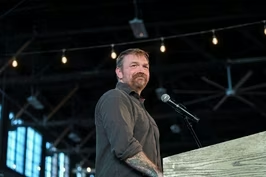
More Democrats call for Platner to drop Maine Senate bid
Video has Closed Captions
More Democrats call for Platner to drop Maine Senate bid after sexual assault accusation (5m 52s)

New student loan rules reshape funding for graduate programs
Video has Closed Captions
New student loan rules could limit funding for some graduate programs (6m 24s)

News Wrap: Attempt to collect election worker info rejected
Video has Closed Captions
News Wrap: Judge rejects Trump's attempt to collect Georgia election worker info (6m 15s)

Trump pressures NATO on defense spending, loyalty, Greenland
Video has Closed Captions
At NATO summit, Trump pressures allies on loyalty, defense spending and Greenland (7m 27s)

U.S. strikes Iran after tanker attacks in Strait of Hormuz
Video has Closed Captions
U.S. launches new strikes on Iran after attacks on tankers in Strait of Hormuz (4m 43s)
Providing Support for PBS.org
Learn Moreabout PBS online sponsorship New Episode
- News and Public Affairs

Today's top journalists discuss Washington's current political events and public affairs.

- News and Public Affairs

FRONTLINE is investigative journalism that questions, explains and changes our world.

 New Episode
 New Episode
 New Episode
 New Episode
 New Episode
 New Episode
 New Episode
 New Season
Support for PBS provided by:
Major corporate funding for the PBS News Hour is provided by BDO, BNSF, Consumer Cellular, American Cruise Lines, and Raymond James. Funding for the PBS NewsHour Weekend is provided by...